1. Calculate the volume
Work in metres, so the result is in cubic metres (m³):
- Slab: length × width × thickness (12 cm = 0.12 m).
- Strip footing: length × width × depth.
- Square column or beam: side × side × height (or length).
- Round column: 3.1416 × radius² × height.
- Multiply by the number of identical elements, then add a waste margin of 5 to 10 % (uneven ground, formwork, spillage).
Using the tool step by step
The numbered marks on the screenshots follow the order in which you use the tool. The fields are filled with an example.
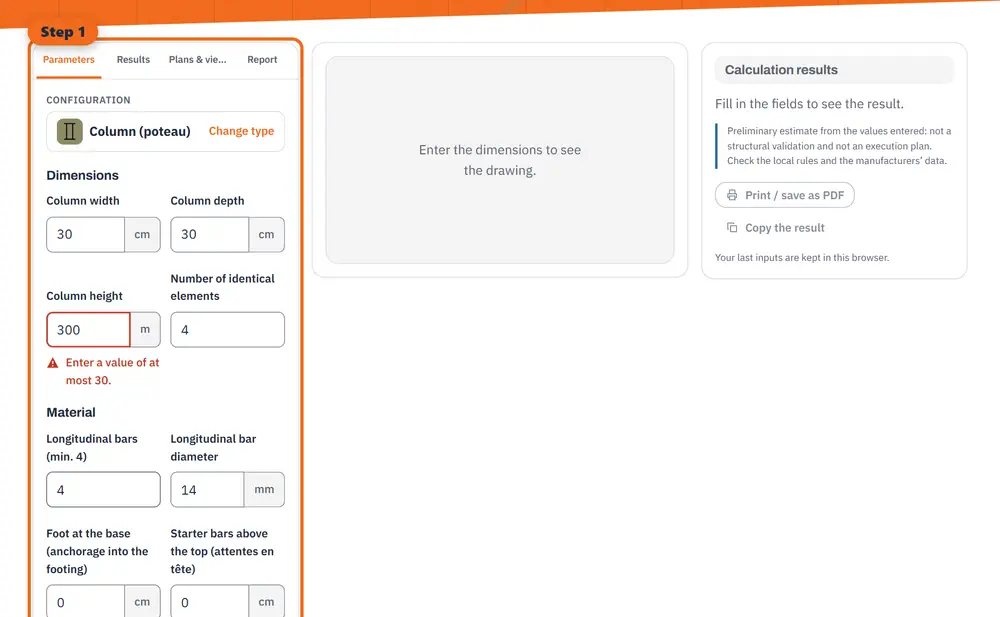
Step 1 Enter your values: dimensions, materials and options. 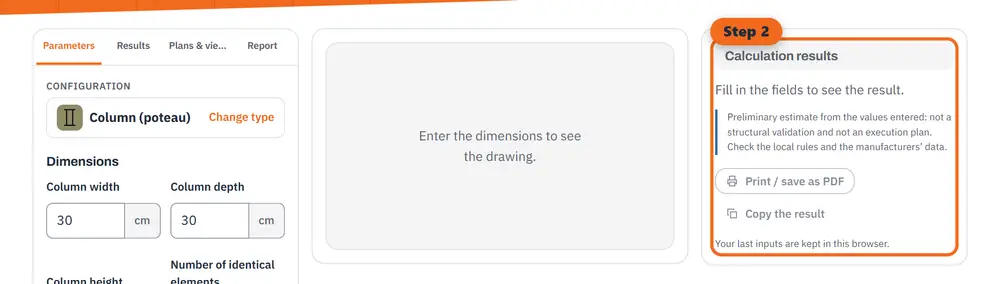
Step 2 Read the results: quantities, costs and estimated durations, updated as you type. 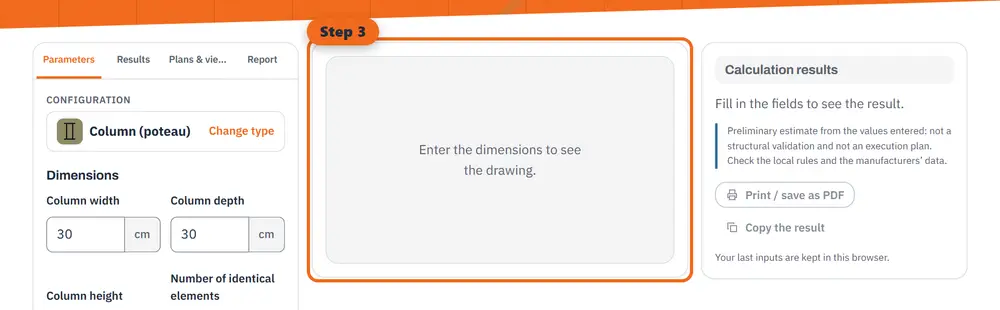
Step 3 Explore the drawing: 3D, plan, section and detail views.
2. Materials for 1 m³ of concrete
A common site mix for reinforced concrete is about 350 kg of cement per m³, with roughly 680 kg of sand, 1,100 kg of gravel and 175 litres of water. Lean concrete (blinding) uses less cement, often 150 to 250 kg/m³.
These are usual starting values, not a structural specification: follow your plans, your engineer or the ready-mix supplier for the strength class required.
Worked example: a 5 × 4 m slab, 12 cm thick
5 × 4 × 0.12 = 2.40 m³; with 5 % waste, 2.52 m³ to order. At 350 kg/m³:
- Cement: 2.52 × 350 = 882 kg, i.e. 18 bags of 50 kg.
- Sand: about 1,714 kg. Gravel: about 2,772 kg.
- Water: about 441 litres, added gradually.
Site mix or ready-mix?
Beyond about 1 to 2 m³, a ready-mix truck is usually cheaper and more regular than mixing on site, and the strength class is guaranteed. Order the volume with the margin, and plan access for the truck or a pump.
For the reinforcement, the rebar calculator gives the weight of steel and the number of 12 m bars; for a thin levelling layer, use the screed calculator instead.
General information, checked at the date shown. It does not replace advice from a professional for your situation.